A Total Eclipse of the Scarp by Kai Michaluk

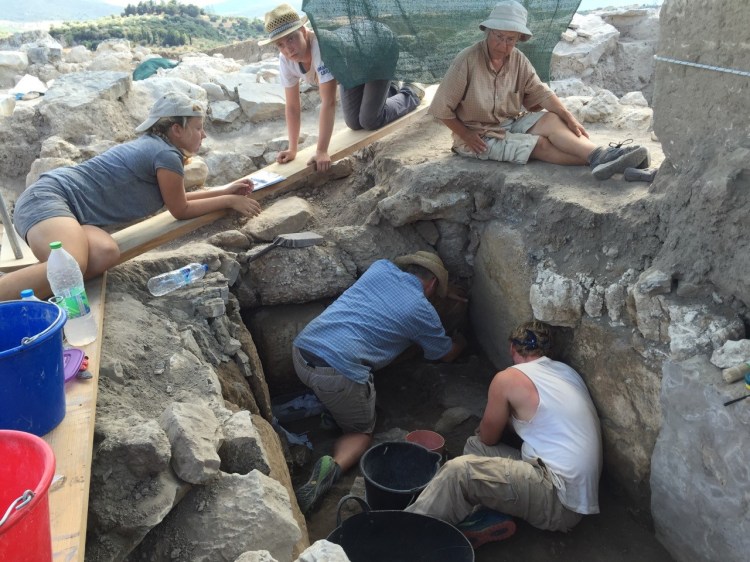
We’re starting our fifth week of the archaeological field study in Boeotia now, and I’ve since been designated the “scarp-master” of the trenches by none other than Sam Bartlett herself; a title I don’t take lightly. You might be asking yourself now what on earth a “scarp” might be. When a trench is dug within an archaeological context, the walls within the trench, which show the stratigraphic layers of sediment, are known as the scarp. There are a multitude of reasons why the upkeep of a clean scarp is absolutely necessary, with the retention of a pleasing aesthetic being first and foremost. Photographic records are constantly being taken during the excavation process in order to properly recall what a trench looked like at any particular moment. The upkeep of a clean scarp in turn provides the viewer with an accurate, and easily viewable representation of the trench in question, so to properly recall the context.

As you might expect, the tools you use to scarp play an important role in the quality of the finished product. A large pick for example, is far too cumbersome and inaccurate in removing the correct amount of soil, while the standard trowel is often too delicate to remove enough soil. In my recent experience, I’ve found that the hand pick gives some of the best results to receive a nice 90° face in the first step of your scarping efforts, as it removes a substantial amount of soil while still retaining a fair amount accuracy; the surface it leaves is often uneven though. Be sure in your endeavours to use only the pointed end of the hand pick unless otherwise specified, as the broad end has the rife potential of damaging any artifacts within the soil. Along with the hand pick are two other tools which have been deemed by the excavation team as the scarpinator (fig. 1), and the laser beam (fig. 2) to further refine the scarp.

As their respective names may suggest, both tools yield an incredibly flat surface due to their broad, sharp ends which work excellent for scraping soil away for the finishing touches. The nature of their handles ensures that an excess of force cannot be applied so to damage any artifacts, providing the user with an ease of mind.

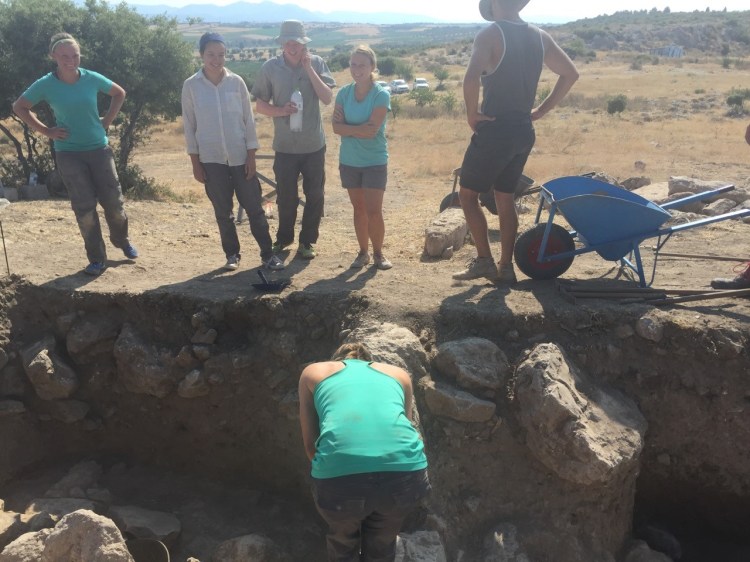
The process of how to execute a clean, flush scarp appears relatively simple on paper, but once faced with the task, the practice has the potential to be more difficult than it needs to be. Many an amateur archaeologist’s first instinct is to start working on the face of the wall head on, but this perspective often makes achieving a 90° wall face very difficult to accomplish. My advice is to tackle it from above, working on it looking downward, as this gives the most precise perspective to retain accuracy (Fig. 3). If the trench becomes too deep and working on it from above is no longer an option, I advise to regularly step out and look down at the wall face to get a sense of accuracy.
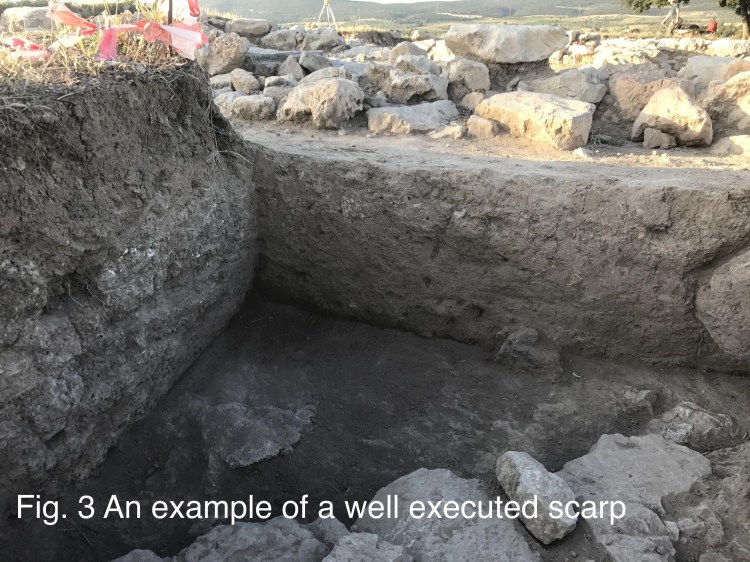
scarp tool 3

These tricks of the trade have lead me to execute some very nice trench walls, and I hope they may aid you in any your excavation endeavours. Happy scarping!
The Unbearable Lightness of Bones – by Novella Nicchitta

The excitement of finding a tomb always brings high expectations, with Grave Circle A being a dreamy reference. The reality of what you deal with most of the time, however, is very different. If you are lucky, you find a fairly well preserved skeleton and, if you are even more lucky, its funerary accompaniment goods.

No matter how pretty, valuable, or particular those may be, there is one part of the process of the tomb excavation that will leave you almost unsatisfied. Once the bones are exposed, in fact, they reveal themselves in all their fragility and crumbliness. The process of excavation requires, indeed, a great deal of patience, lightness, and attention. First you brush all around them, eliminating the loose soil in the attempt to elevate them from the rest of the dirt while maintaining their position and shape. Successively, a more detailed process begins with trying to define the bones. We use the smallest tools in order to contour and individuate their first characteristics: whether left or right tibia, whether a man in its prime or a younger individual. Even for an expert, the identification can be problematic for the particular characteristics and shapes have been smoothed or destroyed over time, leaving very few clues and space for guess.

Despite all the precaution you may take, those timeworn bones will blow to pieces like dust in the wind, crumbling in your hands and under your eyes, and there is not much you can do to avoid it. One moment they had shape and form in the soil, now they are only amorphous fragments closed in a box, whose value and purpose are mostly reserved to the expert eye of an osteologist. Some of them come in so many tiny little fragments that they are not even worth to be saved in a box, so they get discharged with the loose dirt and the soil they were resting in.

Every detail, from location to positions, matters in order to infer why the corpse was left there alongside all its social connotations, but sometimes its mysterious story cannot be revealed. Was this person belonging to a specific social group? Is there a relation with the other tombs around? What was the cause of death? Was this tomb disturbed? Answering these questions on site is not very easy and the whole process requires thought and further study. Everything can get even more complicated as the tiny little bones can float around due to infiltration or to human disturbance, turning themselves into a skeletal puzzle that is difficult to reassemble.

Overall, finding human bones is a remarkable moment, in which one of the primary goals is the willingness to preserve and respect the remains of an individual, no matter how long ago he or she lived and, whenever possible, try to answer some questions regarding a whole civilization.

A Day in the Life of the First-Aid Kit – by Hamish Frayne


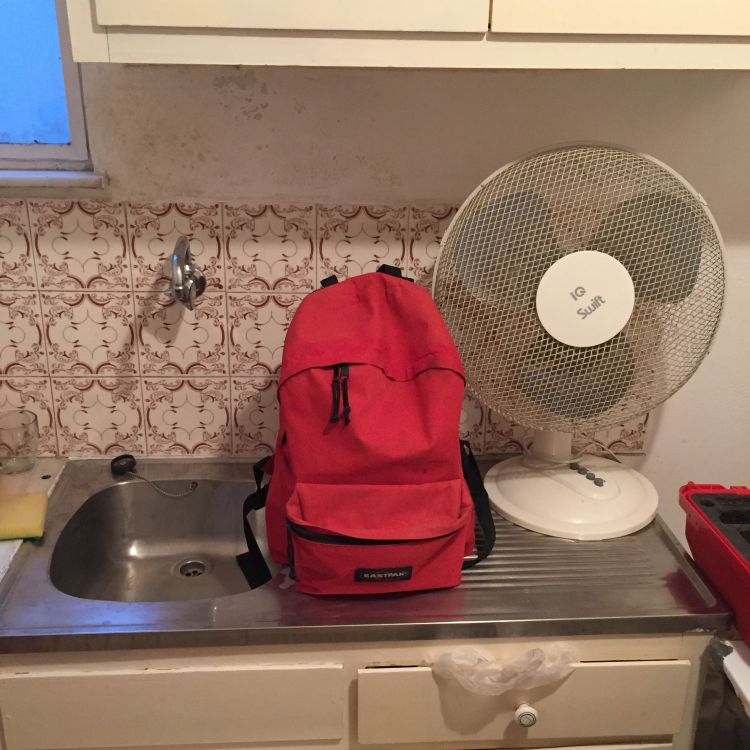
IMG_3422At 5:56 am the door opens. Light streams into the room as a brown Columbia hat with a Wintersport T-shirt shuffles into the room and begins packing up the total-station batteries charging peacefully on the table to my left. Soon after, a man with an Adidas hat and a green T-shirt enters the room and grabs one of my straps, startling me. This is how a day as the first-aid kit generally begins.
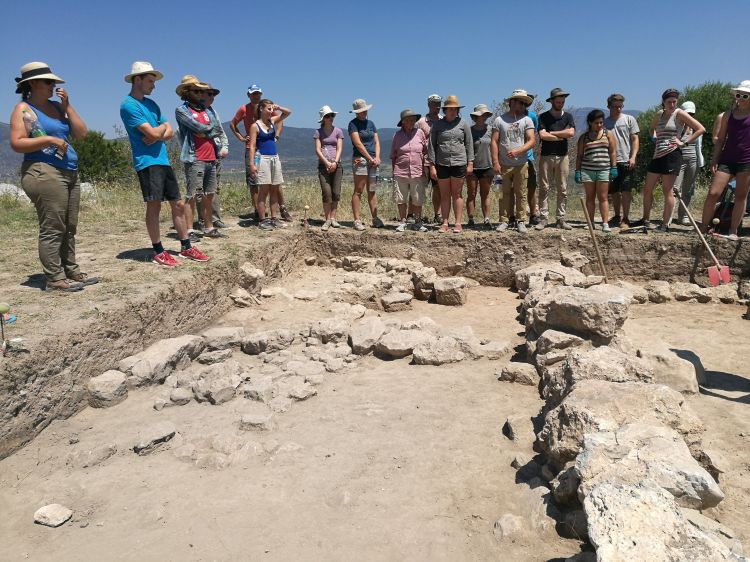
I am carried outside to see a mob of people adorned with T-shirts, hats and cargo pants all patiently waiting to load into large metal transport vessels. After a few moments of waiting I am carelessly tossed into the rear of one such vessel. We depart and I suffer half-an-hour of bumps, twists, turns and lurches. Afterwards, I am carried up a steep hill with a gorgeous view of the surrounding farmland. Shockingly, my escorts hardly consider their surroundings but merely trudge up the hill with their heads down. I get placed casually in the shade up against a large tree, and there I wait patiently until needed.

My first patient calls around 7:30 am. A man with a large sun hat, a white (??) T-shirt and slightly too much sunscreen on his face unzips me and pulls out a pack of Almora. My next call comes at 9:12 am as a slightly sun-baked female with a blister on her left thumb rummages through me in search of polysporin and a band-aid. I try to recommend the anti-septic spray, since the polysporin expired in 2011, but my suggestions fall on deaf ears (expired polysporin is better than nothing I suppose).

At 9:45 am the humans congregate around the tree in a daily ritual, and I generally provide a few band-aids at this time. Near the end of the congregation a tall man in a blue shirt with bloodshot eyes opens my small pouch and removes eye drops. One of his contact lenses has collected some dust, and I supervise as his fellow human helps administer the drops into his irritated eye.

My next patient comes much later at 11:08 am. By now the humans are slightly heat-exhausted, as evidenced by the quality of the jokes I overhear, making careless injuries more likely. Someone accidentally struck the ring finger of their nearby colleague while pick-axing dirt, so I provide acetaminophen, soothing cream and bandage-wrap to a woman grimacing in pain; fortunately the injury seems nothing more than a bad bruise.

The humans have another congregation around 11:30 am, although everyone is considerably less exuberant by now and I generally remain untouched during this process. Only as the gathering ends do I provide some Almora packs to people who need a boost to get through the rest of the day.

As 1:00 pm arrives, the man in the green shirt and Adidas hat (which has now been replaced by a much larger garment described as the “Sun Protection Zone”) examines my contents to ensure I am still packed appropriately. We begin the descent down the hill followed by the usual jarring ride home. At last I am removed from the transport vessel and returned to my usual home in the Office, knowing that tomorrow the entire process will begin anew.

Better late than never

Our 2017 season is well underway. Today we began week five of our six week season. The team is made up of about 30 colleagues and students from Canada, the US, Greece, Italy, and Poland. In the early weeks we had quite a bit of rain but now the rain is gone and the heat has arrived: 35 (95 F) today! Everyone is working extremely hard and the work is going well. We are extremely grateful to our colleagues at the Thebes Museum and the Ephoreia of the Antiquities of Boeotia who help us so much in our work.

What follows will be student blogs which are part of our field school course through the University of Victoria. Students are asked to write in an interesting way some aspect of the excavation, to provide the reader with a sense of what it is like to be on an excavation in Greece.

IMG_20170623_120115.jpg

Join Our Team 2017

application-2017

Upcoming Season: May 28 – July 8, 2017

Project Overview
This project investigates an unexplored settlement in central Greece (Boeotia), dating primarily to the Mycenaean (ca. 1700-1150 BC) and Classical (6-4th c. BC) periods.  Ancient Eleon operated within the orbit of the major Greek city of Thebes throughout its history.

Volunteer Program: Student volunteers will participate in all aspects of fieldwork, learning stratigraphic excavation techniques, recording methods, and artifact analysis. The program offers experiential learning and is physically strenuous.

All student volunteers must be in good physical condition and able to participate in all aspects of the fieldwork.

Upon acceptance to the program, participants can enroll in GRS 495 Practicum in Archaeology (3.0 Units) for university credit from the University of Victoria. Qualified non-UVic students can get UVic transfer credit to their home institution. The course will include training sessions in field techniques, topical lectures, and optional field trips.  It is possible to participate as a volunteer in the excavation without enrolling in GRS 495 for credit.

All participants, whether enrolled in GRS 495 or not, will be required to pay a $3000 program fee which will go toward room and board for six weeks. UVic tuition for GRS 495 is separate, as is transatlantic airfare. The excavation team lives in modest, shared apartments in the nearby town of Dilesi, which offers swimming in the Euboean Gulf, internet access, and public transportation to Athens, approximately 1 hour away.

EBAP 2016: Looking Back and Looking Ahead

After six hard weeks of work (from May 30-July 9) we can report that 2016 was a great a success at ancient Eleon. We had a very good team of dedicated students and scholars often working 14 hour days in the field and apotheke. A preliminary report of our results will be forthcoming, first to our Greek colleagues in the Ephorate of Boeotian Antiquities and to the Canadian Institute in Greece. We will also present our work at the Annual Meeting of the Archaeological Institute of America in January 2017, this year in Toronto.

The site in Arma is now thoroughly covered and protected for the winter. We are already making preparations to return in May 2017 to continue this important research. In 2016 we made some very exciting discoveries and were able to answer some significant questions, but, as often happens with research projects like ours, the work has resulted in new, intriguing questions.

Our project is highly dependent on external funding. We welcome donations from individuals and institutions who are interested in supporting our research of the Greek past. Donations also go a long way toward supporting dedicated students from Canada and the US who gain valuable work experience with us, excavating, cataloguing, and studying newly uncovered artifacts. Our project provides transferable skills and prepares people for a whole range of careers. If you are interested in making a contribution, please contact Brendan Burke (bburke@uvic.ca) or Bryan Burns (bburns@wellesley.edu).  Thanks for reading – see you in 2017!

EBAP v WARP – Jessica Jenkins

Survey vs. Excavation: During my time as an undergraduate in Classical Archaeology, I’ve had the opportunity to participate in both a survey with the Western Argolid Regional Project (WARP) and an excavation with the Eastern Boeotia Archaeological Project (EBAP). While at EBAP, I’ve been asked many questions about which I like better and what the differences are between them. Both are important archaeological processes but are very different, especially as a student out in the field. This post will highlight the characteristics of survey and excavation in general and will also discuss differences and similarities in procedures and technique.

Main Goals: When one embarks on a survey, the goal of the project is to obtain an all-encompassing archaeological view of a large region. Generally work is done in square kilometres rather than square meters, which allows for a big picture view. Survey is used to identify potential sites (areas with high densities of material) and is commonly used to select promising  areas for future excavation.

In contrast, excavation is a very detailed picture of a small area. It commonly occurs after a survey has taken place, like here at EBAP, but also occurs when features or artifacts of interest are found. Excavation usually includes uncovering architecture or artifacts below the ground surface in a systematic way.

In the Field: I generally like to relate survey to cardio and excavation to strength training. While participating in survey I spent my days hiking around the Greek countryside, through well-tended agricultural fields or jungles of prickly maquis. Every day I got to experience a different view, and by the end I had seen a significant portion of the Argolid plain. I also had the opportunity to meet a variety of people, especially the farmers who seemed not to care that a group of archaeology students were walking through their fields.

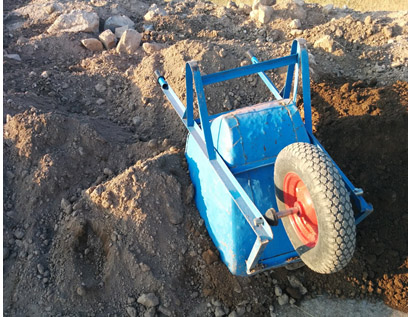
Excavation, in comparison, requires a lot less walking and a lot more lifting. From big picking to wheel-barrowing, the entire six weeks are spent moving as much dirt as possible. The season is spent at a single site, which allows me to really understand the history of Eleon and the archaeological processes taking place. Even though I walk up the same hill every day, I always looked forward to understanding more about the site and finding something which has remained in the ground since the Mycenaean period. I also find that working on a project as multi-disciplinary as EBAP has allowed me to get a glimpse of many of the facets of archaeology that I may otherwise had not been able to explore such as osteology or conservation.

Overall, both surveying and excavating are important pieces to the archaeological process, but are very different when compared to each other. I truly do not prefer one over the other because I have been able to have such interesting experiences in both. I hope to participate in more surveys or excavations because they really are two pieces to one puzzle.


After Hours at EBAP – Emily Candell

emily blogLike any due date for a report or an exam, the end of our excavation period crept up on me, as I’m sure it did for most.  You can tell by the piling pottery sherds, the larger-than-normal circles under everyone’s eyes, the frantic looks while sorting flotation (no doubt recalling how many crates are on the porches), and the decreasing number of social people at ouzo hour.
Of course, everything exciting happens at the end.  Which is great, really, but generally results in more last-minute work, including returning to site after lunch for a few lucky volunteers.  Enthusiasm has to run high for these returnees, because pulling a 12-13 hour day in 35 degrees Celsius (95 degrees Fahrenheit) takes a special kind of crazy… and they must be ready to bring that same energy back at 6 am the next morning.

If you are one of the crazies, you are left both incredibly excited and incredibly drained.  A few things to know before venturing to skip your day-off and tag on an extra 6 hours to your work day:

A) Brains begin to melt. Once upon a time, you had a name all to yourself. Then suddenly, you become Jess, Steph, Austen, or all of the above and begin to respond to any name besides your own–since “Emily” becomes synonymous with “blonde girl” and surely cannot be referring to you.

B) Laughter attacks (a side-effect of the melting brains). You think I mean laugh-attacks, but that would be misleading; I mean that laughter literally attacks the trench in an unstoppable way. It appears out of nowhere.  Be prepared to annoy everyone around you to the point of getting kicked out of the trench, especially when sharing a precariously placed board that bounces when sitting and laughing (this was the instance when I first saw Steph’s death glare, which I had wrongly assumed was not possible).

C) Great surprises are assumed to be dreaded chores. Example: Brendan announces that he has such a surprise for you in the afternoon. You immediately assume he intends to send you, during the hottest part of the day, to clean the massive polygonal wall that radiates heat and blocks any wind.  In fact, he plans to bring everyone iced coffee. (… However, this may be something that naturally happens when you’ve been surprised by Brendan too many times.)

D) Dinner does not wait for you. While obvious, this one cannot be missed. If you expect to come home and casually clean up in an attempt to look nice for our 8 o’clock dinner, you’ll be sorely disappointed.  Tops, you will have 20 minutes between exiting the car and forking the Greek salad, which is generally gone within 5 minutes, because, well, everyone’s last meal was at 2 pm.

E) Good memories accumulate. Despite the tough work, the reward is enormous.  Not only are you shell-shocked with the realization of what you’ve uncovered and what it means for the rest of the project, you are also strangely reluctant to head home, though your body has come to the end of its rope.  And with so many fun new friendships, built on the back of shared-struggle and excitement, the only way to say goodbye is to say, “See you soon!”

This beautiful country has a truly wealthy culture despite its economic situation.  The kindness of its people, the impact of its history, and even its sweltering heat will be missed by this first-time excavationner.

Laugh attack:

Emily blog laughing

Six Weeks with EBAP Cianan Butterfield-Stinson

cianan

What was I expecting when I decided to join the EBAP team? Not much really. Only during my second term of my second year at University did I really decide on anthropology being my major. It all started with a presentation at the beginning of my Greek and Roman 200 class that I learned about this program and what would result in one of my best summers so far. Previous to this experience I have only had one second year archaeology class which taught me the basics of archaeological research as well as problems that are faced within the field. While it was very informative and provided me with an idea of what I was getting myself into, it didn’t prepare me for what an amazing journey this experience would be.

Being immersed in a site and working right in the trenches can not be replaced by any lecture. Swinging a pickaxe into the soil and scraping the bulk wall with a triangle trowel is so satisfying. After these six weeks I have learned how to use these tools, along with many others, to the fullest in terms of technique and efficiency. Even something as simple as a dustpan or a broom will never be looked at the same without thinking of how much soil I swept up every day and wheelbarrowed to the mountain we call the spoil heap. Unfortunately, I have not had the joy of experiencing troweling in my sleep which people have warned me about. What I have experienced is every part of my body being sore at one time or another.

One obstacle that worried me was whether I would get along with the people that I would be working with for half the summer. This is something you do not necessary need to worry about in a lecture. I was very lucky to have a fantastic group of people to work with and get to know. Relationships formed here can happen as easily as having a pottery washing buddy or with the roommates you are assigned with. In a classroom setting, it can be more awkward and less organic. Being able to see and work with the same people every day can create stronger bonds and lifelong friendships even after they go back to their respective homes. This is easily one of this most important aspect of the program for me.

Another aspect of this experience I enjoyed is being able to work and interact with professionals and students in my field of study as well as a variety of others. It is great how archaeology can utilize a number of different skills people have and combine them together, no matter if it is to do with technology, art, or sheer power. While being here I have also figured out a clearer idea of what career I would like to pursue after obtaining my degree. This is mainly because of my interactions with people here and being able to share ideas and learn from others. This has put my life on a new trajectory that I am thankful for.

Coming to Greece has always been a dream of mine, but I never expected to come here for an excavation. This experience has taught me many skills that will transfer to my future pursuits no matter what they are. Who knows if I will end up in archaeology as my future profession. What I do know is that I will never regret my discussion on whether I should have come here. I think this is a fantastic program to be involved in whether you are in the field or not and recommend it to everyone.