Reflections of the stone Pope – Frank Babuin

This post will be a sort of review of my experience and the ups and downs I faced during my six weeks participating in excavation during the EBAP 2016 season. The first week of my on site experience was filled with a variety of learning opportunities. After an initial few days of site tours and cleaning of the trenches, the excavation finally began in earnest. During this first week I learned many of the basic procedures and techniques involved in excavating an archaeological site. These included but were certainly not limited to how to properly use a pickaxe or hand pick in an archaeological context, how the actual procedure of excavating a trench worked (for example, when it is or isn’t appropriate to change locus or how to identify soil changes and why that may or may not be important). Now, most of what I encountered during the first week of excavation I had been introduced to previously in my studies, however, I quickly discovered that there is a massive difference in learning how something works in theory in a classroom and actually being there and doing it for yourself. Because of this, the first week was perhaps the most beneficial to me personally in my time at ancient Eleon.
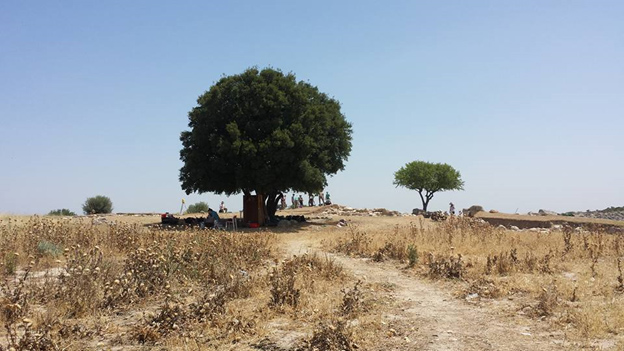
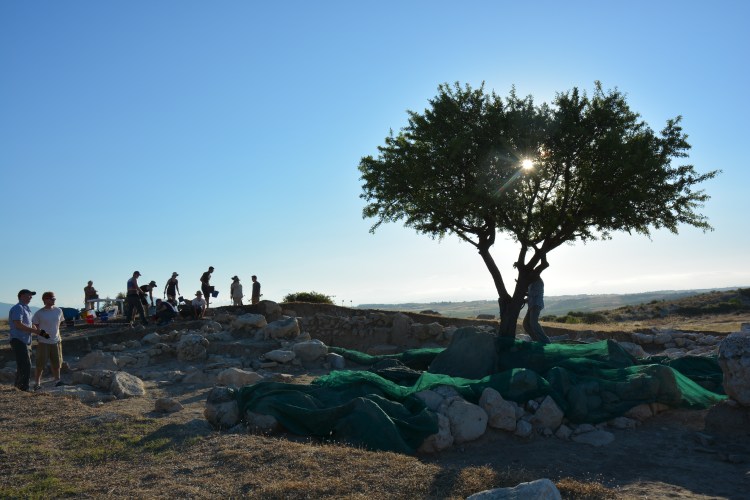
Frank blog photo

Week two brought about a somewhat welcome change of scenery as I was re-assigned to work in a new trench. While week one had certainly been beneficial in the sense that I learned a plethora of beneficial skills that I will carry with me into any future archaeological endeavours, I would be lying if I said I wasn’t a tad disappointed with the lack of excitement in that initial week of digging. This new trench had, at the time at least, appeared to have more potential for exciting finds and was definitely the place to be in my mind. This new trench, at the time, was the only one with what appeared to be the tops of walls, or any actual architecture for that matter. I was disappointed, then, to find that even though we knew (or in some cases, thought we knew) that there should be walls and other interesting things in the trench; it would take us many days of painstaking work to be able to uncover them. Again, I knew that archaeology was a slow process going into the dig but the excitement of actually being there myself and being the one actually doing the excavating made everything seem to go by 10 times slower.

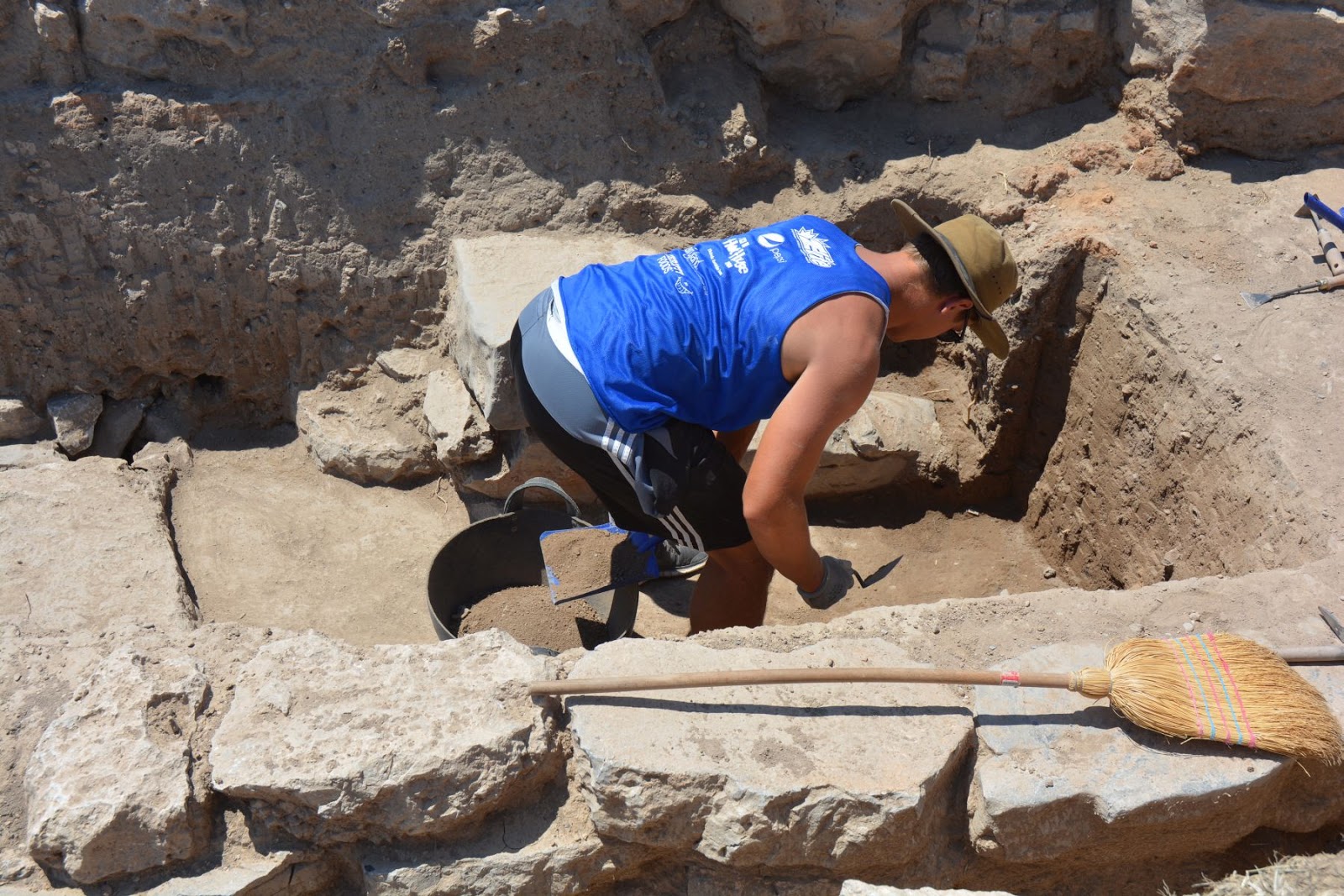
A couple weeks into the season, it was decided that we would open another new trench beside the one that I was working in. During the first day or two of digging in this new trench we came across many, many fist sized stones. In order to better see what was going on, we were instructed to leave them in and clean around them and brush them off as best we could. I was, for whatever reason apparently quite good at this, so good, in fact, that my trench supervisor Uwe jokingly called me the “Stone Pope”. This ended up being quite an appropriate nickname because, even as many of my trench mates were switched in and out to do various other things both on site and at the apotheke (our pottery analysis building) I stayed in this particular, stone filled trench for the majority of the season.

As the season went on, I slowly grew more and more frustrated with our seemingly empty trench. Whenever we would find something that we thought could be important or interesting it just turned out to be more useless stones. In fact, I was beginning to lose all of the initial optimism I had had and was beginning to think we were just digging up what was essentially a trash heap of stones.

But then it happened. Finally, after weeks of nothing, we found our first blue stone! It may seem insignificant but this one find really turned my entire EBAP experience around from one of frustration and disappointment into one of excitement and optimism. It is one thing to read in a textbook or hear in a lecture about some exciting find that an archaeologist of their team made during an excavation, but it is another thing entirely to be there and experience it firsthand. In fact, I would go so far as to say that, even if we found literally nothing at all for the remainder of the excavation (which we certainly did), this single find would have made this entire experience worthwhile. It was an extremely satisfying feeling to finally find what we were looking for after weeks of hard work and I couldn’t have asked for a better team of people to do it with.

What Happened to Week Three?

Time is flying by. Last week’s major accomplishment was the removal of a LOT of earth and stone moving. The aim is to remove obstructive material so that we can see and excavate buildings and levels we know to be there. Sometimes we rely on our students for the heavy lifting, but on big projects, we also get help from our Greek collaborators who bring in special lifting equipment. We are very grateful to the Ephorate of Boeotian Antiquities and to the town of Arma which provided the lifting expertise and equipment.

Week Two: Eleon, Thebes, Athens

Soon this blog will be updated by our students. This entry will provide an update on our excavations at Eleon, report on a great celebration for the Thebes Museum, and a note the conference in Athens where results of our work was presented.

E15_5376.JPG

The second week of excavations went very well. More progress is made to uncover the important remains of the Blue Stone Structure. The complex is quite large, extending toward the north and east. We revealed a heavy packing layer of rubble fill that was most likely part of the earthen mound erected over the structure. For greater visibility and to understand better the architecture we unfortunately had to remove a tree onsite as well. Our very helpful and enthusiastic neighbor, Mr. Panagiotis, happily cut it down and was glad to have the valuable firewood.

Thebes Museum

New Thebes Museum Opening 7 June 2016

On Tuesday, a few senior staff members attended an opening celebration of the New Thebes Museum. The president of Greece was in attendance along with several other very distinguished guests. Our colleagues, and the Thebes Museum Director, Dr. Alexandra Charami hosted the event and kindly acknowledged our successful collaboration at ancient Eleon in her speech. Below shows EBAP team members attending the Thebes Museum opening and viewing jewelry mould from ancient Eleon, among other finds, now on display.

On Saturday, Bryan Burns and Brendan Burke attended the 40th Anniversary Conference of the Canadian Institute in Greece. This two day event was well-organized and highlighted the wide range of work by Canadian scholars working in Greece. Excavations at ancient Eleon were featured in two talks, one focused on the Bronze Age remains and another on the Archaic and Classical material. After the conference, speakers and guests were invited to a great dinner under the Athenian Acropolis.

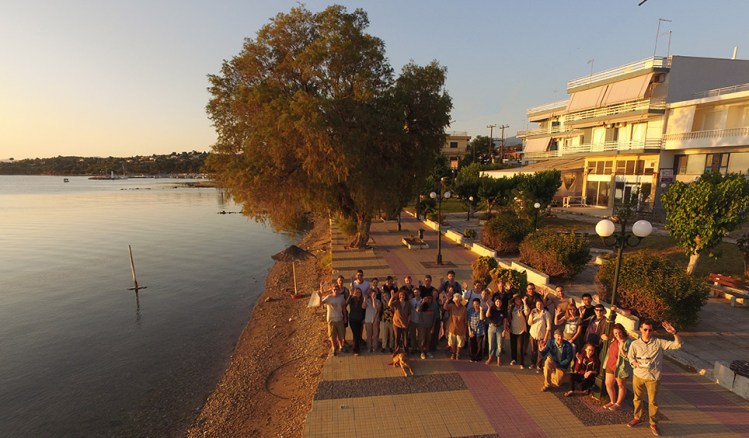
DCIM100MEDIADJI_0248.JPG

2016 EBAP Group in Dilesi


Week One 2016

Our first week of work for the 2016 season concluded yesterday. Returnees and new-comers to the project are all settling in very well to our daily routines. We depart from Dilesi as the sun is rising over Euboea. Our caravan is made up of four cars and one van. The routes to the site vary but take about 20-25 minutes. Nearly all of us listen to the local, eclectic radio station (FM95, N-R-G). Some bring breakfast with them for the commute.

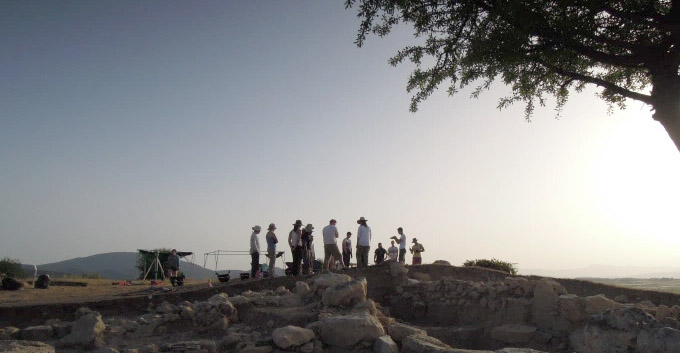
dawn

On site we number at least 20 people and the first hour or so is spent getting the tools out and equipment set up. Applying sunscreen is also a must. Trench supervisors are mapping out their day’s work, making tags and labeling buckets for the daily finds. Currently we are concentrating our work in two trenches with about five to six students in each. Our architect arrived late last week and came directly from the airport to the site, after a transatlantic (Toronto-Athens) flight! Her dedication and enthusiasm is an inspiration to us all.

In the apotheke – our processing and storage area – our team works to conserve finds and study the various deposits of ceramics. We also have our drawing and digital Eleon teams located there as well. Photographic Evidence Part II

Our on-site workday ends around 1:15 when we break for lunch in the village. This is prepared for us by our incredibly helpful partner, Stavroula and her family. The food is always delicious and traditionally Greek. Most pile back into the cars and we return to Dilesi for a few hours of rest and relaxation. Some swim, others nap.

Work resumes at 5 pm for sherd washing and processing and other necessary parts of excavation life. We work until about 7 pm, have a light refreshment before dinner at 8 at a nearby seaside taverna. Most of the team is in bed by 9:30, ready for the next day.19279-_mg_8764

Technology and Archaeology

by Ashley Hopper
 
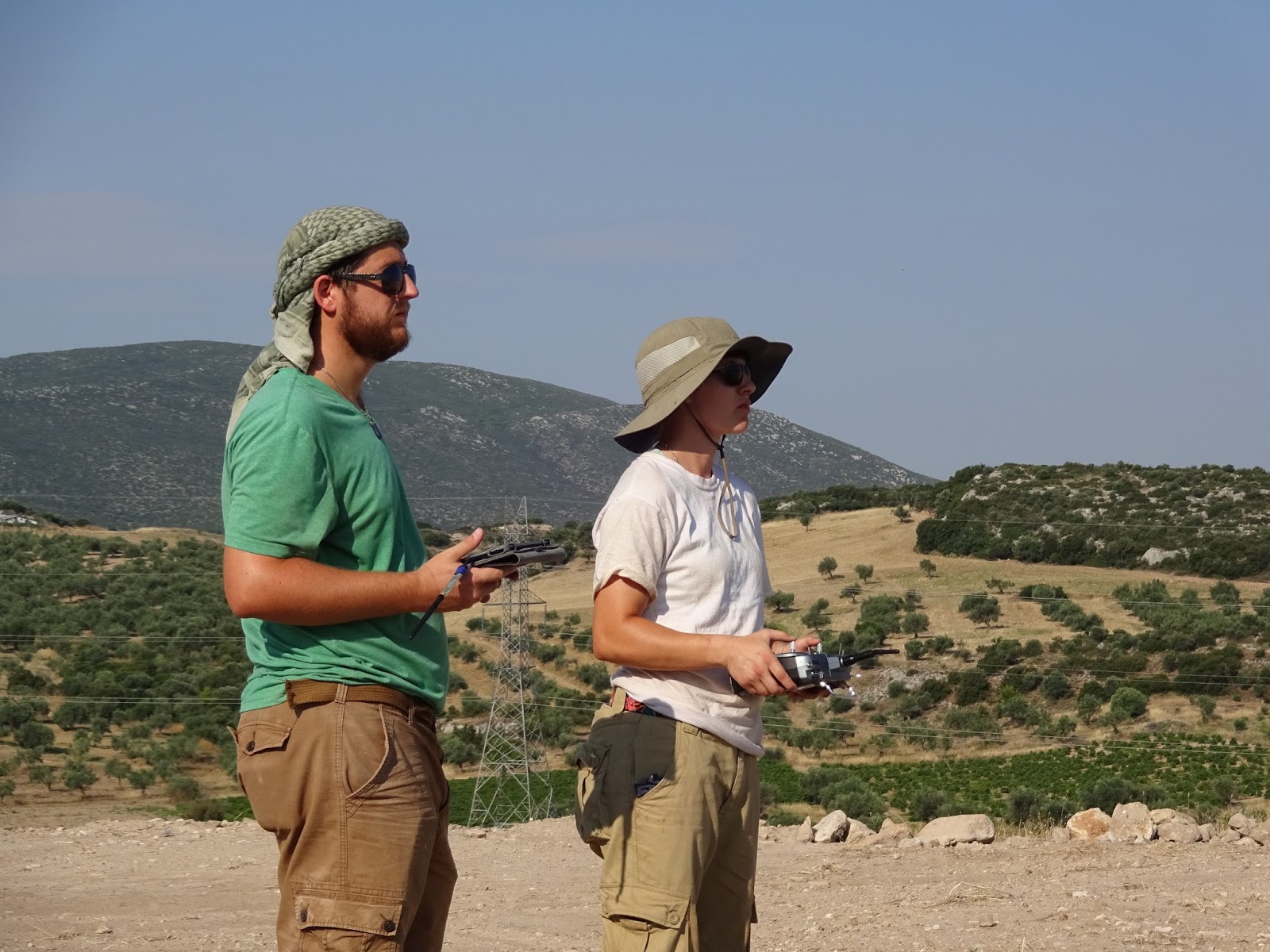
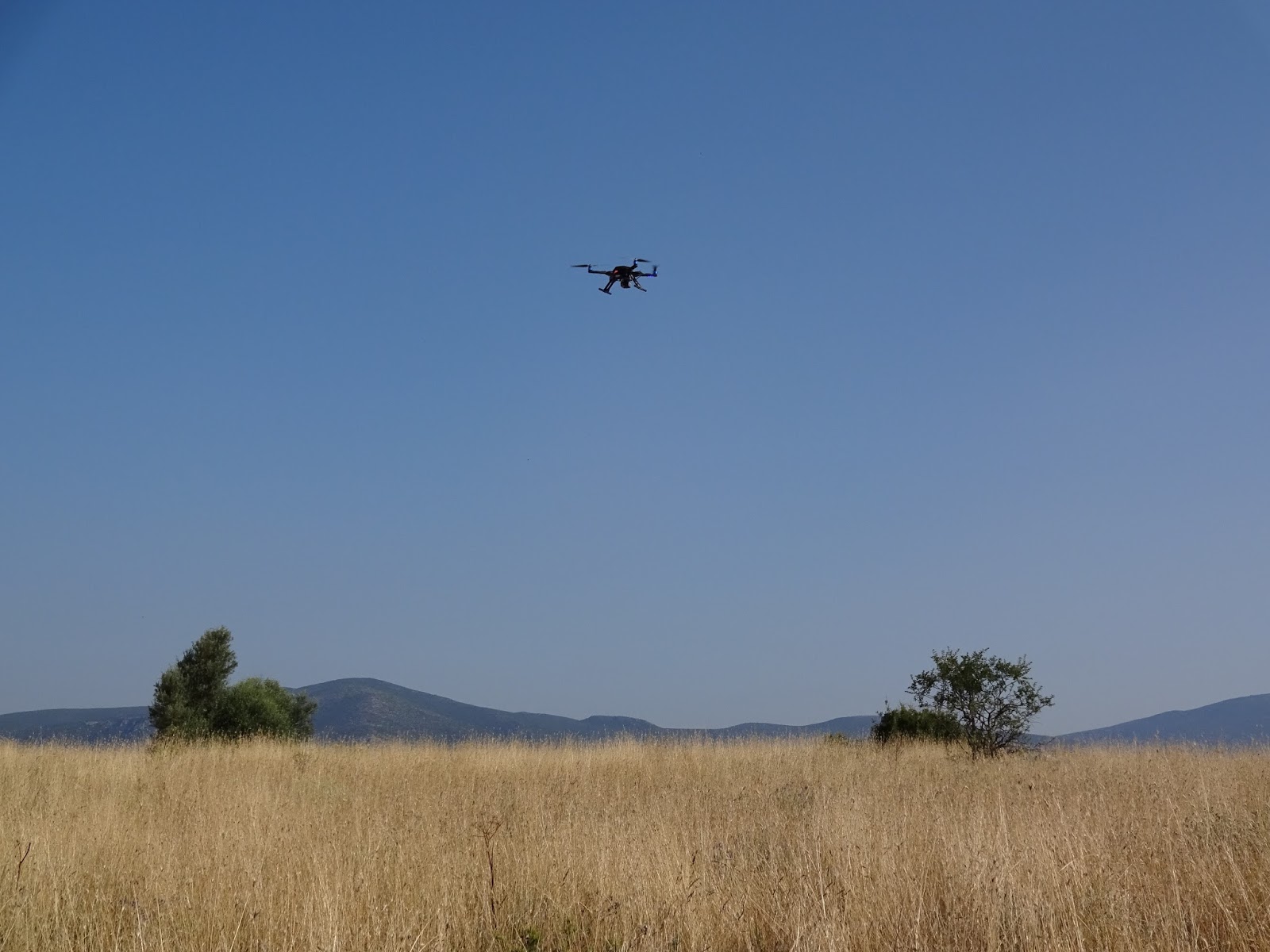
For the first time this year, we had the opportunity to use a drone to take aerial photography of our site. They did have the drone last year, however, they never got the chance to take high quality photos of the site due to some rather unfortunate mishaps. Jordan Tynes, a professor from Wellesley College visited us for a week to help teach us about the technology and take photos of the site. Kaylie Cox, a fellow student and aerial protégé, was Jordan’s assistant and took over for him when he had to leave. She is quite the expert on drone technology already.
Flying the drone is a two-person operation and requires careful coordination so the drone won’t crash. A Go-Pro camera is attached to the bottom of the drone, while photos are taken using the time-lapse setting with two photos being taken every second. While one person is controlling the drone, the other watches the timer so the battery won’t run out. The battery only lasts for eight minutes of active flying, making it very important for the co-pilot to give regular updates on how much time has passed. The highest that we have seen the drone fly over the site is 125 feet but Kaylie would not recommend going over 100 feet due to the drone’s sensitivity to wind. With such thoughtful consideration of the elements, there have not been any crashes yet!
This technology is important for archaeological sites and excavations because it can document changes from the air that might not be as noticeable from the ground. It gives us a bigger picture of how things are progressing on site and provides a different perspective for our photography. It also gives us a direct overhead view of the site compared to our photography taken from the ground, as it is not always easy to take photos from the ground due to awkward angles or positioning.

The only downside to the technology is that it can only be used in certain weather conditions. We had to learn this the hard way one day when we rushed to clean up our trench but it turned out that the wind was too strong for the drone to fly. It will be very interesting to see how drone photography on archaeological sites progresses in the coming years!

Advanced Excavation Techniques: The Future Digger

by Vaughn Gaston

Advanced Excavation Techniques: The Future Digger

(A Non-Intentionally Alliterative, Complimentary, Semi-Collaborative Continuation of Mr. Jones’ Previous Blog Entry)
            Throughout the history of archaeology, evolved methods have allowed for increases in information acquisition and advancements in archaeological accuracy. We have total stations, digital databases, and chemically literate conservators. However, the lowly laborer attains no newfound skill, performing techniques that just might be as old as archaeology itself. Thankfully, that is all about to change.

            Please be cautious in attempting any of the following presented techniques, as many of them require considerable balance, excellent physical coordination, and perhaps a couple of extra handfuls at nut break. Additionally, anyone with a history of cardiac illness, weak lung capacity, or lack of mental fortitude should refrain from the following, or consult a specialist before attempting to engage in any of the activities listed below.

The Flying Sherd:

 The name is self-explanatory. An accurate sherd toss into a pottery bucket can save the time and energy one requires to constantly walk back and forth. Plastic buckets are recommended, not metal, in order to reduce impact, and possible sherd damage. Also, this technique should not be used with faunal material, as it is often far more fragile. Lastly, if one is especially concerned with the well-being of airborne material; the “alley-oop” method may be initiated.
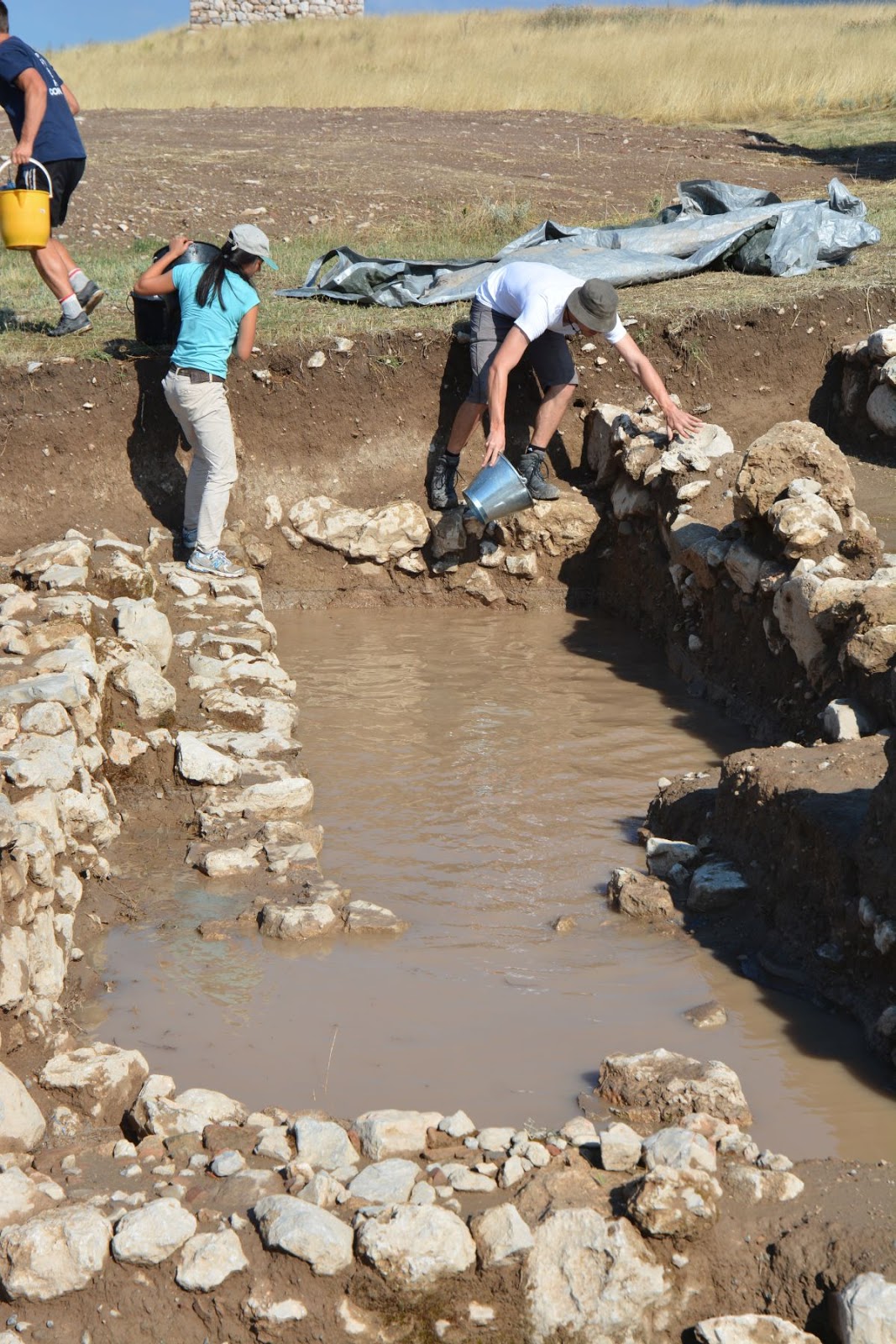
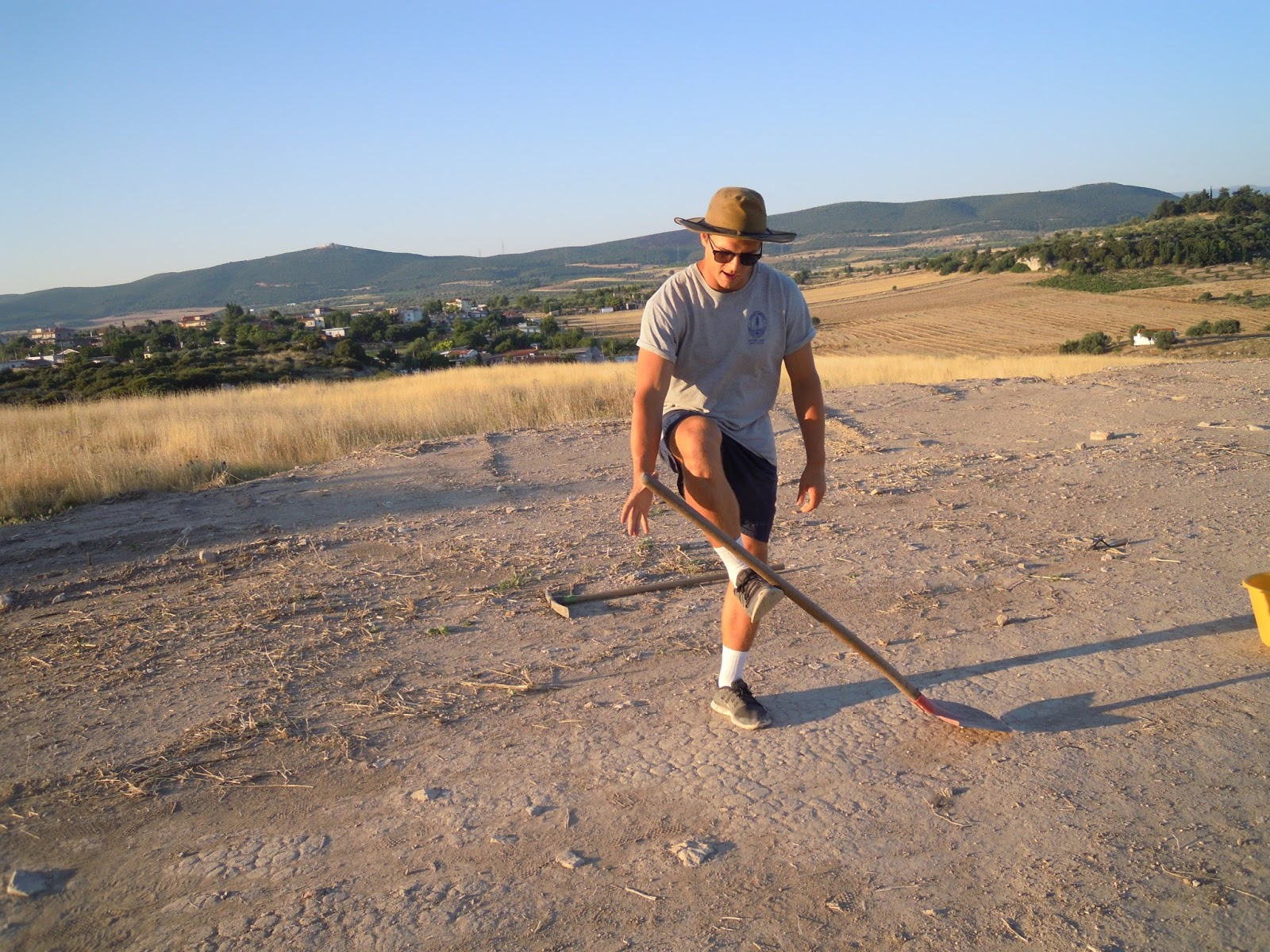
The Reverse-Through-The-Legs Dustpan and/or Shovel Disposal:

Once again, the title of this technique is description enough. It is a technique found most useful in tight, awkward spaces, in which zembili placement options are adequate at best.

The Schliemann Shuffle or The Heinrich Hop:

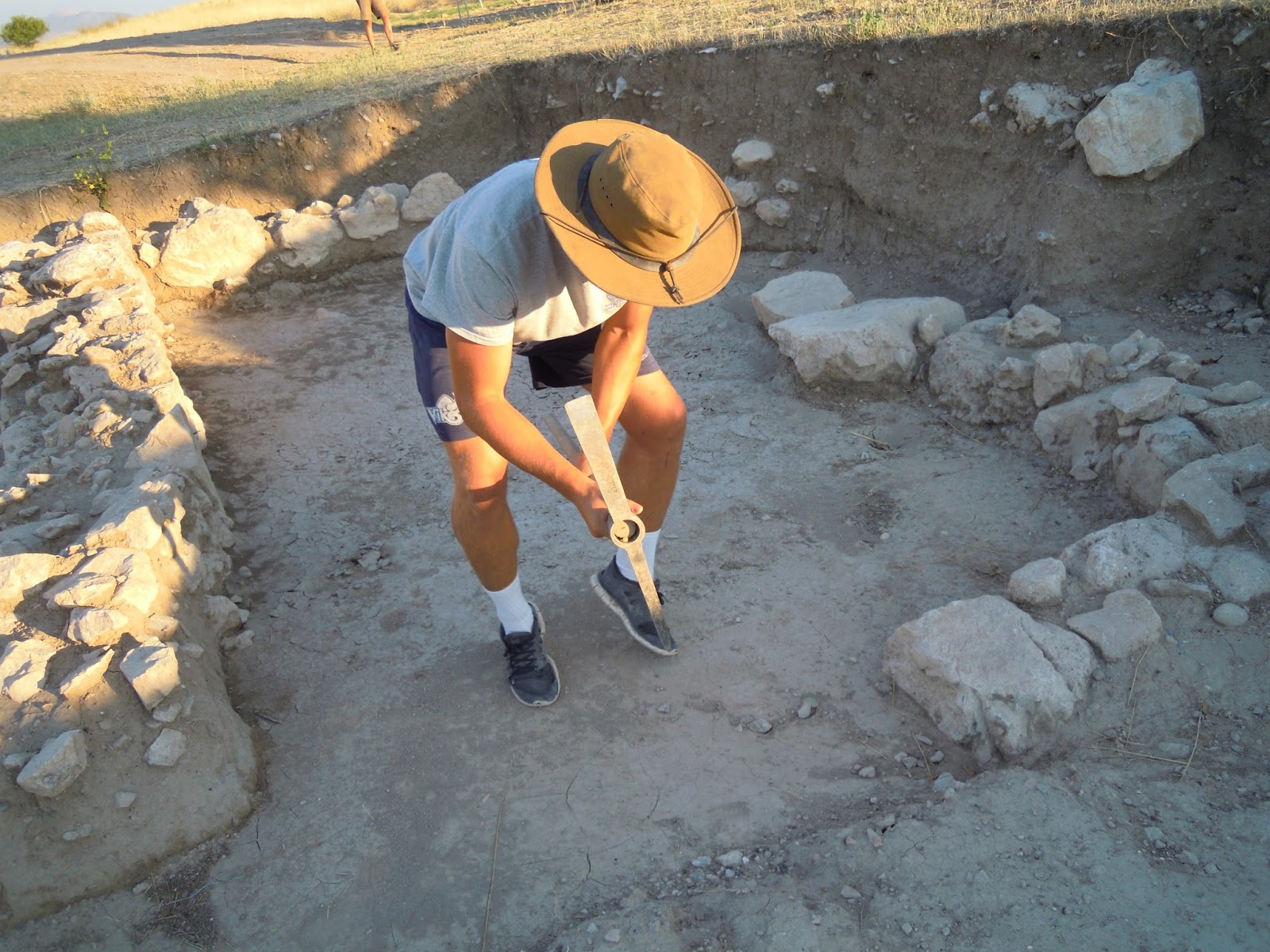
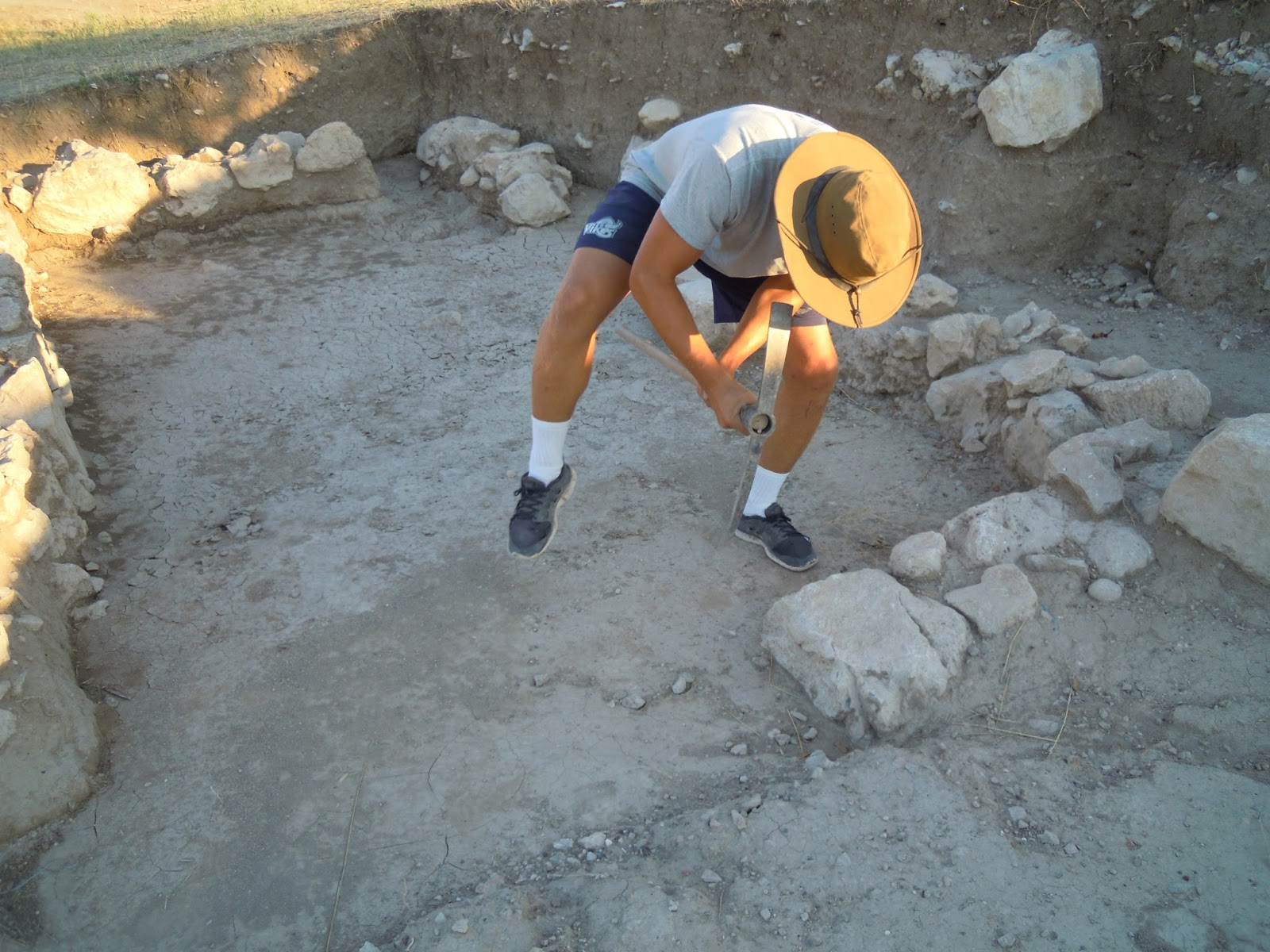
It depends on the region: in Beotia it is referred to as The Schliemann Shuffle, and in Attica, The Heinrich Hop. To perform this technique, simply make a lateral two-step hop to move positions while digging with a pick. The technique is conducted in order to maximize picking efficiency, covering more ground without having to reach, therefore preventing possible muscular injuries.

The Foot-Flick and Catch:

The brilliance of this technique is due to its simplicity. By catching the shaft of ones’ hand-tool with the laces of the shoe, the fall is cushioned, the floor of the trench avoids being marked, and energy is not wasted by bending down to slowly place a tool. Furthermore, the opposite technique may be applied by sliding one’s foot under the shaft of a grounded hand-tool and lifting/flicking the foot; raising the tool in a quick but controlled motion. This technique not only maximizes labor efficiency in terms of speed, but also saves ones’ lumbar region from a possible chronic injury. Plus, it looks cool.

Shirts, Shorts, and Sherds:

Although this next technique is more indirectly related to excavating than the previous listed, a freshly washed, crisp garment can make a 5:00AM rise almost pleasant. However, it can be difficult to find time for doing laundry within the busy schedule of an archaeologist. And of course, properly cleaned archaeological materials are essential to any successful dig. So, this technique is quite straightforward: sherd washing and laundry at the same time.


The Stratigraphy Sommelier:

Few archaeological laborer grunts are savvy with the information one can gain if they are able to recognize things like soil changes, various stratified layers, material inclusions, etcetera. So, this technique allows for even a mindless pawn to notice a subtle, significant event that may occur in his or her trench. To excel at this technique, one need only to lick every bit of earth, rock, fauna, flora, and ceramic available in the surrounding environment, constantly. Eventually, one will acquire the skill to distinguish different types of stone based on their texture against the tongue, or even, taste a date.
            Although it is safe to say that the field of archaeology will never be the same, the provided examples serve merely to scratch the surface of archaeological technique advancement. Lastly, It is important to note that many of these techniques may be combined in several ways with the groundbreaking tool technologies presented in Mr. Jones’ earlier blog entry.


Tools Required for Excavation: An Archaeologists Tool Kit

by Sydney Giesbrecht
Every good archaeologist has a set of essential tools used daily on site. While some are more important then others each plays an important role in excavation.


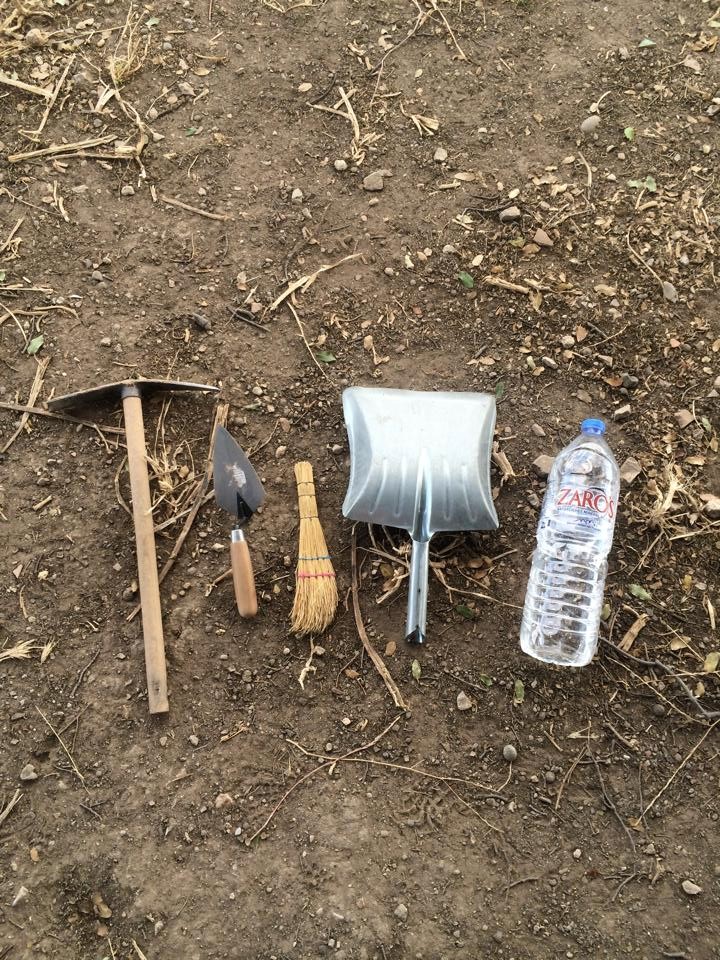
The Small Pick:

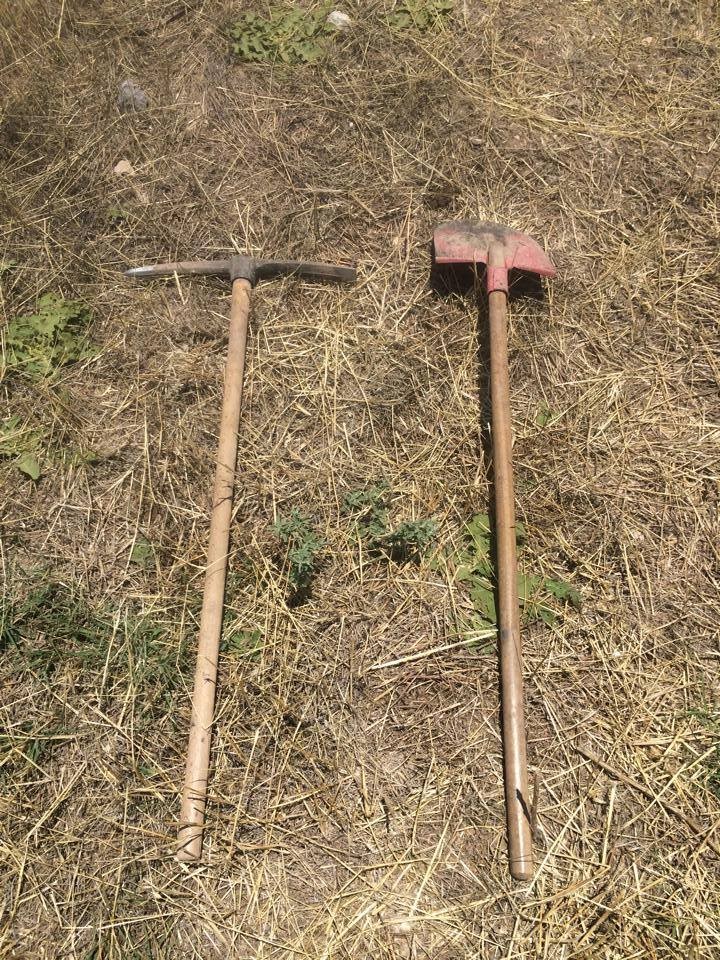
Required for more detailed work such as articulating large rocks or cleaning a bulk at the end of the day. A pick does less damage then most other tools because when breaking into the earth there is only on small point of contact rather than with a shovel where more extensive damage can be done due to its width.


The Trowel:A multipurpose tool.

Sometimes it feels as though there is nothing that a trowel cannot do. During my first few days on site the trowel felt awkward in my hand and I wasn’t quite sure of its full purpose. Now after 5 weeks on site it fits naturally in my hand, almost like an extension of my arm. A trowel to an archaeologist is like a scalpel to a surgeon. Since arriving on site not a day has gone by that I have not required my trowel. It can be used for a variety of things on site ranging from scraping a bulk to examining soil changes on a surface, or simply collecting dirt into a dustpan. It’s most important use in my experience is for checking for changes in soil on a surface. For example if you are working on a surface using picks and shovels you may not notice a change in soil density that clearly. If one area is denser or more clay like then another, a quick scrape on the surface with the edge of your trowel will help to clarify any changes.


Brush:Necessary for all cleaning styles

The brushes found on site range from paintbrushes to large brooms. Small straw brushes as shown in the image above are particularly useful for brushing off rocks and cleaning uneven surfaces. Paintbrushes can be used on site for more delicate work and gentle cleaning in order to not damage or displace the item being excavated. For example if you were to come across a mud brick that you wanted to articulate and photograph a paintbrush would to the least damage.  Larger brooms can often be used on harder surfaces at the end of the day to clean up, in a similar fashion to the way you would sweep the floor at home.


The Dust Pan:

While dustpans may seem insignificant in day-to-day life they are very important at an excavation site for soil removal. When working in smaller areas where a shovel is not an option, the dustpan is a lifesaver. Also very helpful at the end of the day to clean up any messes created during excavation. A clean trench is the best kind of trench.


The Water Bottle:Most important tool of all.

Without water nothing can be done on site. This may seem silly but dehydration is no joke here at EPAB.  With hot days and lots of physical activity you can become ill very quickly if you aren’t drinking lots of water. The average team member will drink 2-4 liters of water before lunch. If you aren’t hydrated you cant dig, and that’s no fun for anyone.

Shovel and Large Pick:
The shovel and the pick go together like peanut butter and jelly. When removing a layer or soil, or making a pass, the pick will be used along with the shovel. Similar to a small pick a large pick is used to loosen soil. Large picks play an important role in the removal of soil, particularly when opening a new trench and getting through the layer of top soil. The pick like make somewhere between a 5-10cm pass and a shovel will follow behind removing the soil being careful not to carve into the newly reveled layer below. This technique is used in order to prevent unnecessary damage to potential artifacts in the soil.


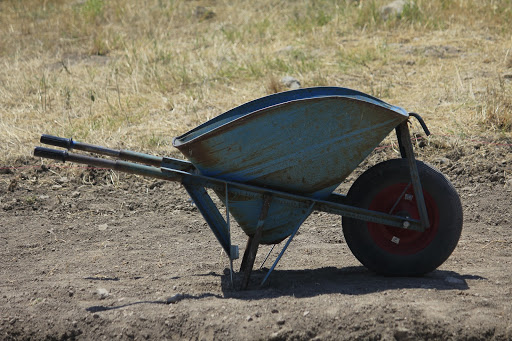
Wheelbarrow and Zambeili:
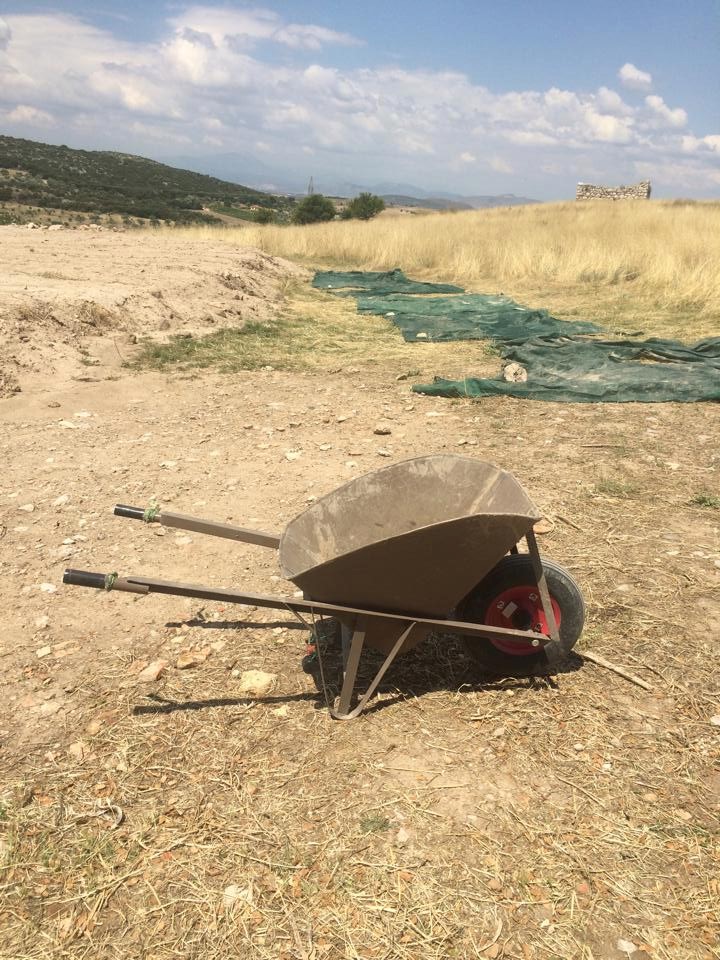
Two tools that are often unappreciated but play an important role on site. A Zambeli is a large rubber bucket placed in the trenches and is very important in removing soil. Soil it transferred from the trenches to the wheelbarrows via the zambeli and then transported to the dirt pile away from the trenches. In order to excavate a site you need to be clean and precise, so soil needs to be constantly moving. Wheelbarrows are often running non-stop all day long on site.


Bulk Scraper: The secret weapon.
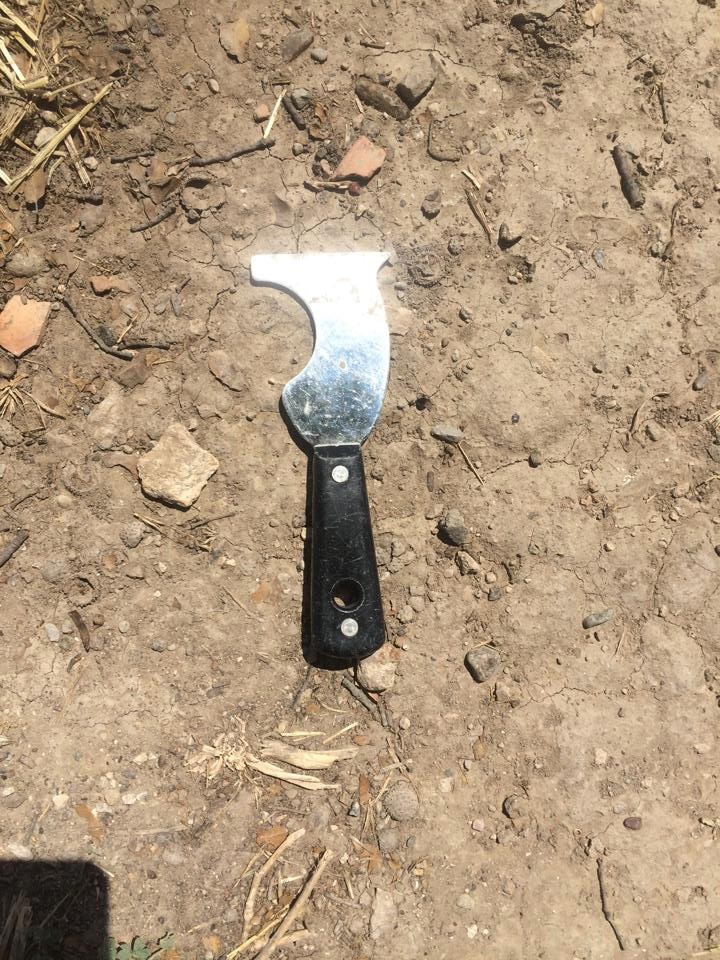
This tool is how you get the straightest bulk walls on site. Archaeological sites are broken down into grid units and on our site each grid is a 5 X 5 meter square. Bulk walls for as you move down into the soil sort of like a small shaft. These bulk walls need to be straight and vertical in order to ensure that you are collecting everything that is within you grid unit. If your bulk slants you could miss an important artifact or feature within the soil. This tool shown above helps to create perfectly flat and vertical bulk walls.


The Search for Ancient Eleon

by Braden Stanley
This summer I embarked on an incredible journey to the beautiful country of Greece to take part in an experience I will never forget. It is hard to captivate the entirety of my experience with mere words, so I decided I would try to express my summer in Greece via video. When I first began this journey I often wondered what exactly I would be doing in the trenches of Eleon. Would I become the next Indiana Jones uncovering the temple of doom, or would I be an average person just moving dirt? As cool as Indiana Jones is, I would have to say that my experience at Eleon was far superior to any adventure that Jones took part in, and I say that for one simple reason…The big pick. In the infamous indy movies you never see Indiana wielding the big pick axe doing actual archaeology, where as in my opinion, there is nothing more satisfying than swinging the big pick doing a clean 10cm pass, and uncovering an ancient history in the process. I feel obligated, however, to mention a particular illness that will take over once the smooth wooden handle first touches your fingers. To the common man your body may just feel warm, as if you have received to much sun, but to the experienced archaeologist it is known as “the fever.” The fever can be described as the irresistible desire to big pick, disregarding all cautionary measures to maintain locus levels and to observe differences in soil change. The fever will take over your body and mind in a way you never thought possible, and without realizing it you will have done three full 10cm trench passes before first break. By the end of the day you will have moved 150 buckets of dirt and ask yourself…what happened to me? Some may say they cannot tell if they have the fever or not, but perhaps the easiest way to diagnose the disease is when someone has been asked to do a shallow 5cm pass, but in reality they were digging closer to 10cm. Your body will do this on its own as it is something you will not be able to control. It will be up to your supervisor to get you out of the trench, feed you a cookie, insist that you take an Almora rehydration tablet, and tell you to go sit under the tree for some shade in order to get rid of the fever for the time being. I myself am burdened with this illness, but I do not intend on treating it. In all seriousness, my time in Greece has been something I will never forget. From the gorgeous beaches of Dilesi to the breathtaking 6am sunrises, from the incredible friendships to the amazing food, this experience will be an ever lasting memory. Being able to take part of an excavation at the incredible site of Eleon cannot be described with words – it is something that you will have to experience for yourself. But I warn you…if you do ever make it into the trenches, beware of the fever. 
Along with the video below, I have included a few time lapse clips to demonstrate the work we do in the trenches – Enjoy!


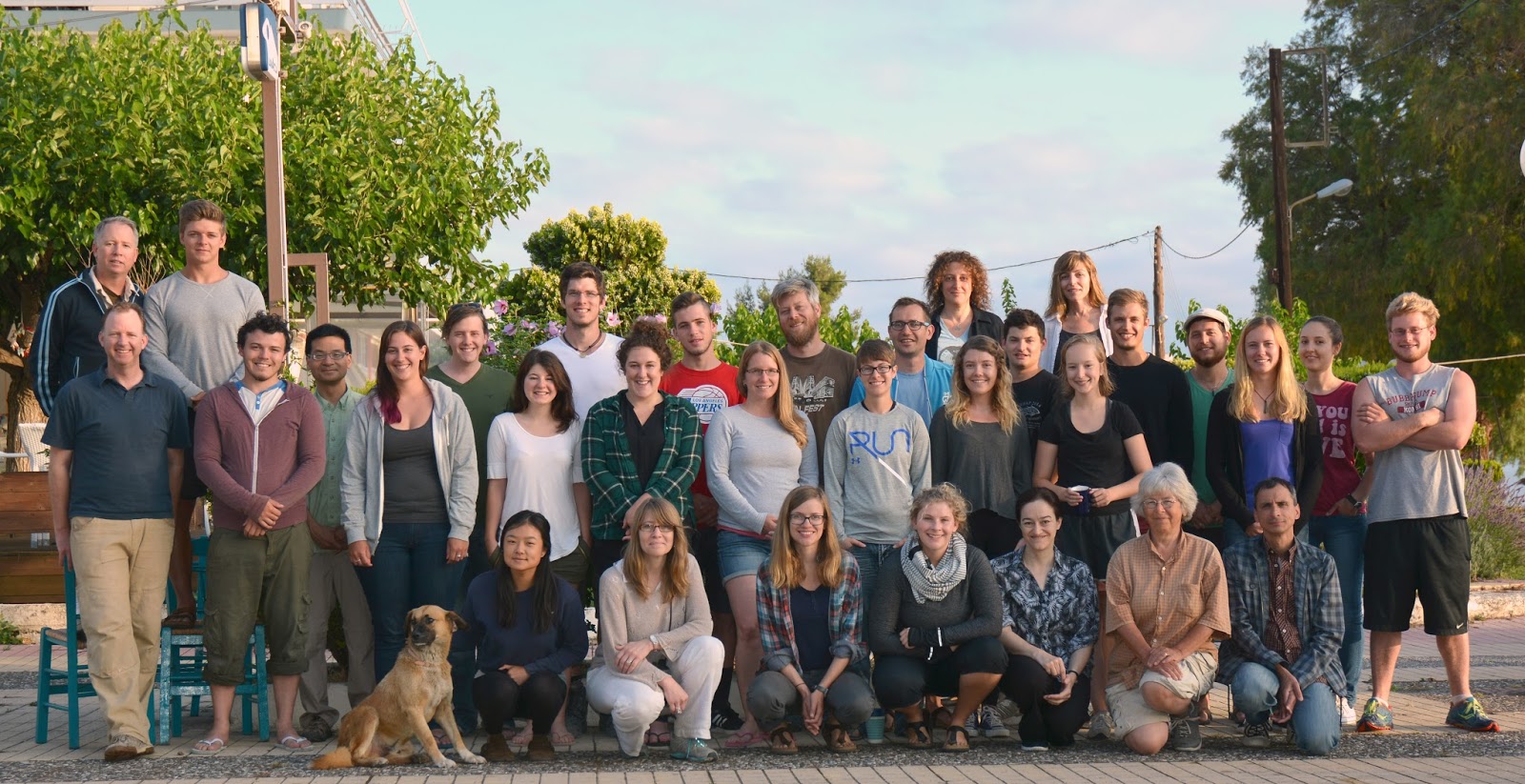
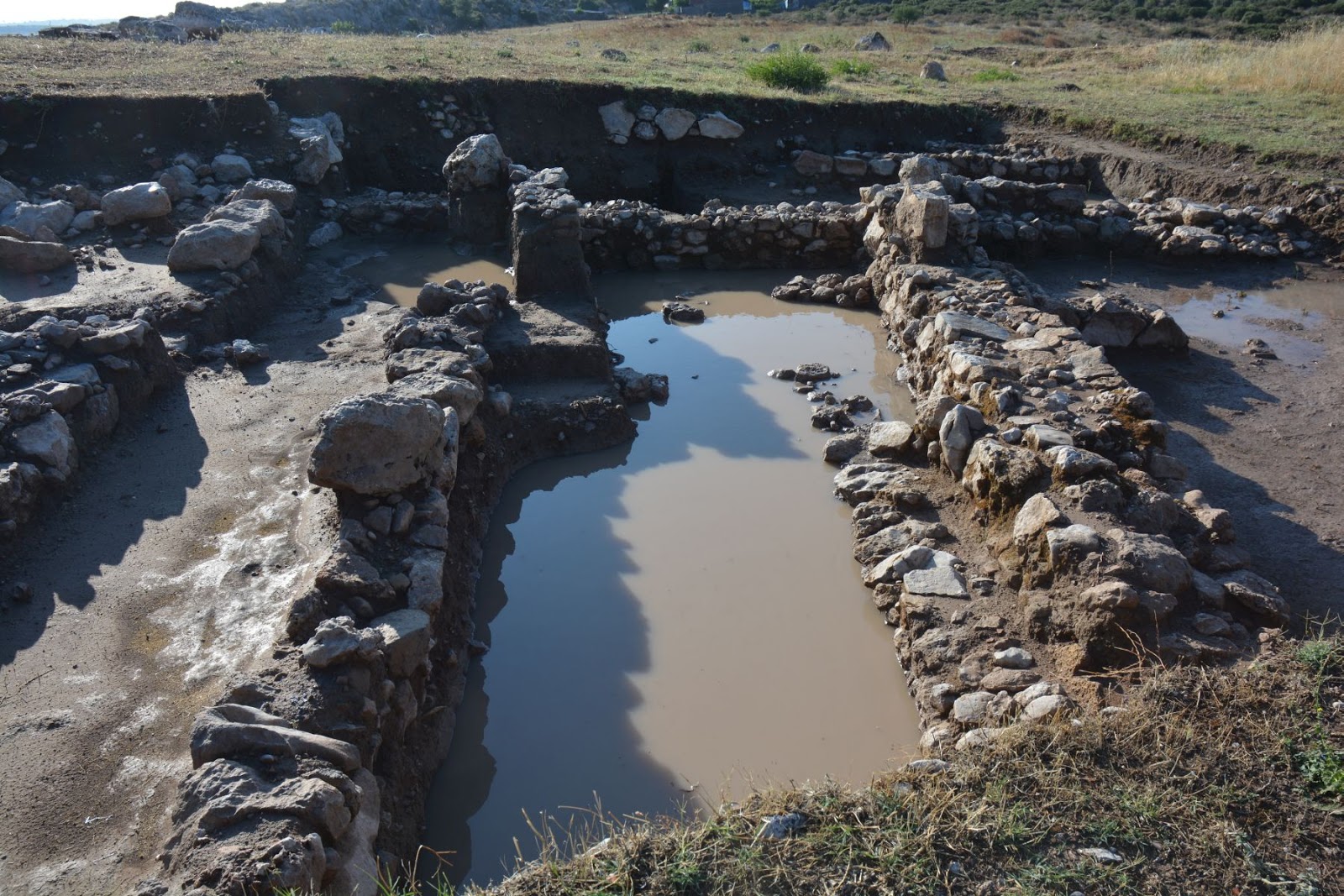
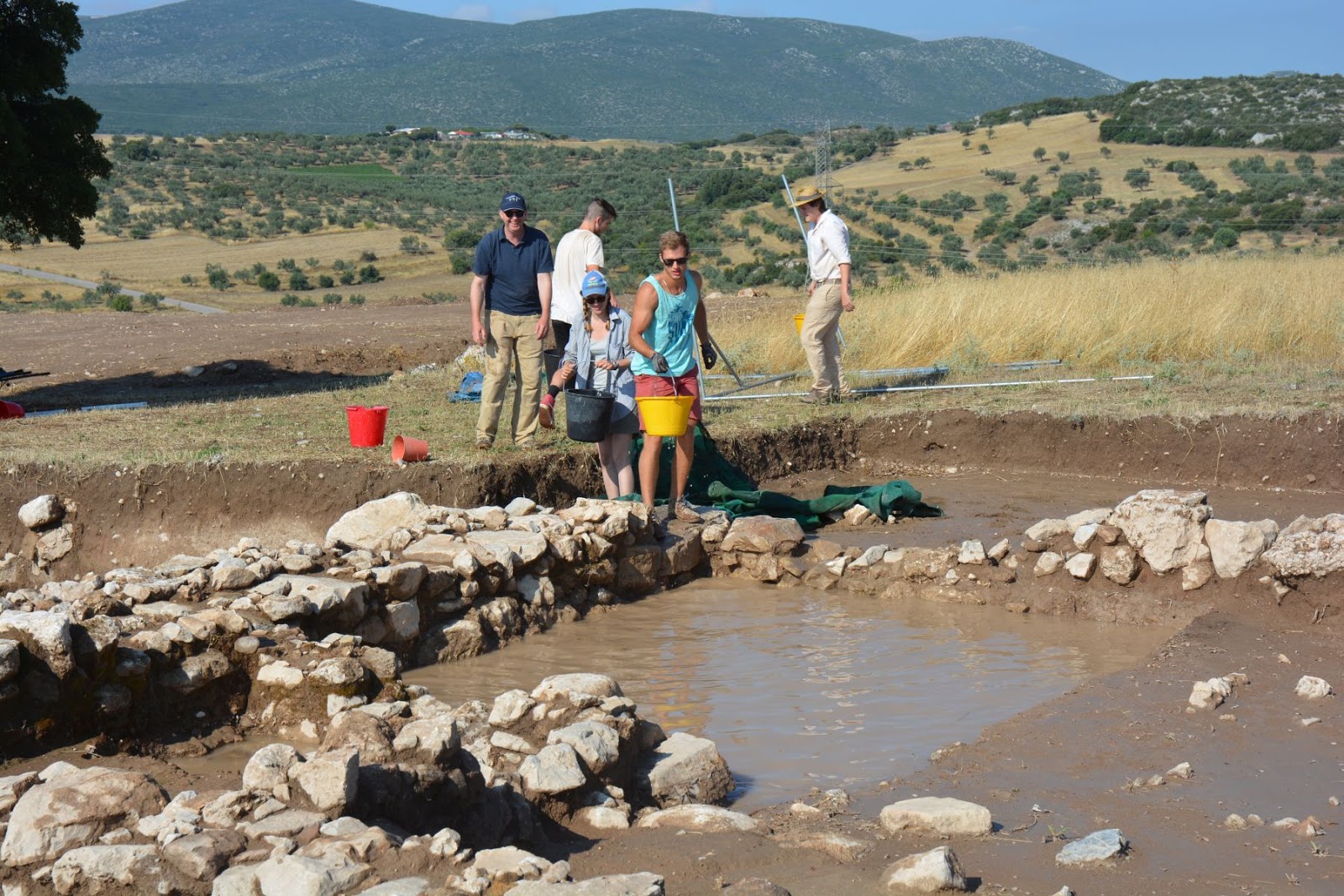
What a great group for 2015! And not everyone on our team is in the photo unfortunately. We took this photo yesterday, on Canada Day. We had heavy rains the night before so we had a very leisurely 7 am start time. Many of us went to the site, others to the apothiki (our work/storage area), and the rest stayed back in Dilesi, for data entry and pottery analysis. I was part of the team that went to the site. What we found was pretty surprising – pools of water in several of our newly dug trenches. 

We assembled a crack team of water-balers and quickly were able to empty the most heavily filled trenches. We let it all dry in the sun and by today we were back in business, more or less. With only a week or so left in the excavation season, every day matters. 
Our students are also going to be blogging a lot more since it’s part of the course requirements – so look out for those. Thanks to the ones who have blogged already – Duncan and Tyler. 
The end will come very quickly for us – as usual we are busy with end of season photos, t-shirts, group photos, etc. Our Greek colleagues came to visit the site today and were as usual very helpful and supportive. We are very lucky to have such great partners during this very difficult time in Greece. This afternoon I was interviewed for our local CBC morning program back home in Victoria. I tried to give a balanced perspective on the choices facing Greece. People are uncertain of the future, of course, and how Greece will manage over the coming days and weeks. My only thought is that something has to happen soon because what’s been going on over the last few years has obviously not been solving the many problems so many people are facing. We hope for the very best for this country that have given us all so much.